
India Can Get World’s First Operational Hyperloop, Virgin Hyperloop Announces Partnership


Hyperloop One’s parent company Virgin has dropped some concrete details about their plans to bring Hyperloop to regions across the globe. Last year, India bagged 2 out of 10 routes selected for laying futuristic Hyperloop tunnels.
According to the latest announcement, the Mumbai-Pune route could witness the world’s first hyperloop test track to facilitate ultra high-speed travel between the two cities. It will be built as a part of the partnership between Virgin Hyperloop One and the Maharashtra state government.
The operational demonstration track is expected to get completed in a time span of three years linking Mumbai, Navi Mumbai International Airport, and central Pune. And the test rides could start as soon as 2021.
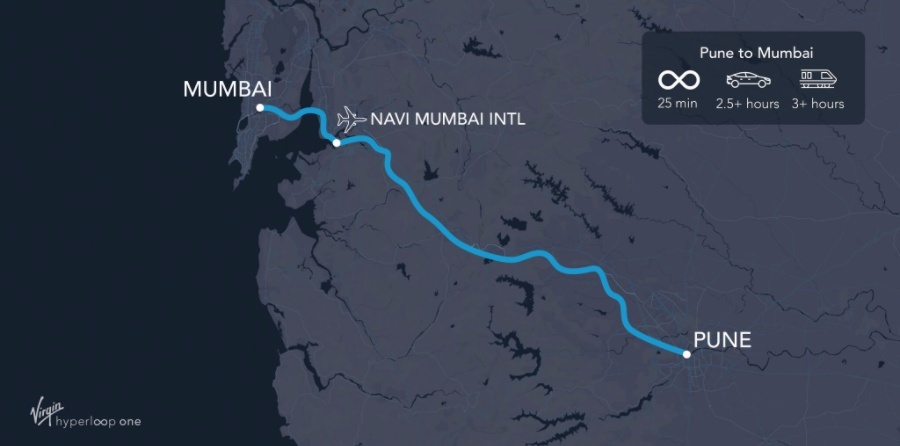
Mumbai Pune Hyperloop One First Route
Virgin’s Hyperloop pre-feasibility studies have shown that after 30 years of operation the Mumbai Pune route could provide a socio-economic benefit of INR 350,000 crores ($55 billion) and cause a reduction in the emission of greenhouse gasses by up to 150,000 tons.
The project would commence after the government gives a green signal to the feasibility report prepared over the next six months. Once finished, the test track between two points in the next three years, followed by the development of the entire route in five to seven years down the line.
Mumbai-Pune Hyperloop would be able to handle around 150 million passenger trips per year while decongesting the always busy expressway between the cities. It would reduce the travel time between the cities to 25 minutes from close to three hours. A future extension would focus on lowering the cargo transit time between Pune and Mumbai’s port. In fact, around 25% of the cargo that passes through Mumbai’s Jawaharlal Nehru port has Pune has its origin or destination.
YOU MAY ALSO LIKE:

Comments

Popular posts from this blog

Chrome Web Browser Will Now Use 10% More RAM With Spectre Fix

A new security feature named ‘Site Isolation’ has been introduced for Google Chrome 67 which would nullify the effects of speculative execution side-channel attacks like Spectre. To put things to the perspective, Spectre is one of the two fundamental design flaws in the  modern processors, which allow programs to get access to the data for which it is not authorized. Malicious data can exploit this flaw to steal your password and other personal information. What is Site Isolation? The new Site Isolation feature introduced in Google Chrome 67 brings about a fundamental change to Chrome’s architecture. Now, Chrome has changed how its multi-process architecture worked and different tabs used different render processes. According to the new architecture, Chrome limits each renderer process to a single site. By this separation of processes, Google aims to prevent direct memory reading across different processes to safeguard users’ data. According to G...

Amazon, Reddit And Others Fail To Warn Us About Dumb Passwords

B elieve it or not, there is still a large number of people who use passwords such as “password,” “password123”, “[dog’s name]1” and others along the same lines. And in the era of sophisticated hacking, these passwords are not exactly “safe.” Before me, this is the first thing websites should inform you while setting up a password. But apparently, many big names are not doing enough to encourage non-terrible passwords, according to  the new research . Steve Furnell from the University of Plymouth has been keeping tabs on the websites like Amazon, Reddit, and Wikipedia for many years, carrying out similar assessments in 2007, 2011 and 2014. His 2018 survey examined practices of Google, Facebook, Wikipedia, Reddit, Yahoo, Amazon, Twitter, Instagram, Microsoft Live, and Netflix. The study concluded that Amazon had the worst performance among all the names. It nearly accepted every kind of password of any length. On the other hand, Yahoo and Wikip...

Is Microsoft Working On A New “Next-generation OS”? Should I Really Get Excited?

I n an announcement that’ll surely spark the interest of Windows enthusiasts, Synaptics hinted at a new “next-generation” operating system from Microsoft. This announcement took place during a conference, where Synaptics and AMD shared their plans to work together to secure the operating systems with a new kind of fingerprint sensor. Here’s what the press release from Synaptics actually said: Further, the new “biometric security OS” gets a mention again along with Windows Hello. The partnership with AMD will reportedly let Synaptics use FS7600 Match-in-Sensor technology, which is completely isolated from the rest of the system and operating system for extra security. It goes without saying that you need to take this news with an extra pinch of salt than the regular rumors that keep making rounds. The next-gen OS from Microsoft could be merely the next significant Windows 10 upgrade. In case you’re a person who loves to think more positively, ...